
How can we compare robots that are expected to move flexibly, safely, and energy-efficiently in dynamic environments? A new international study titled A Benchmarking Framework for Embodied Neuromorphic Agents, published in the prestigious journal Nature Machine Intelligence, offers an answer.
The study was conducted with support from the ROBOPROX project, with a significant contribution from Matěj Hoffmann of ROBOPROX RA9.
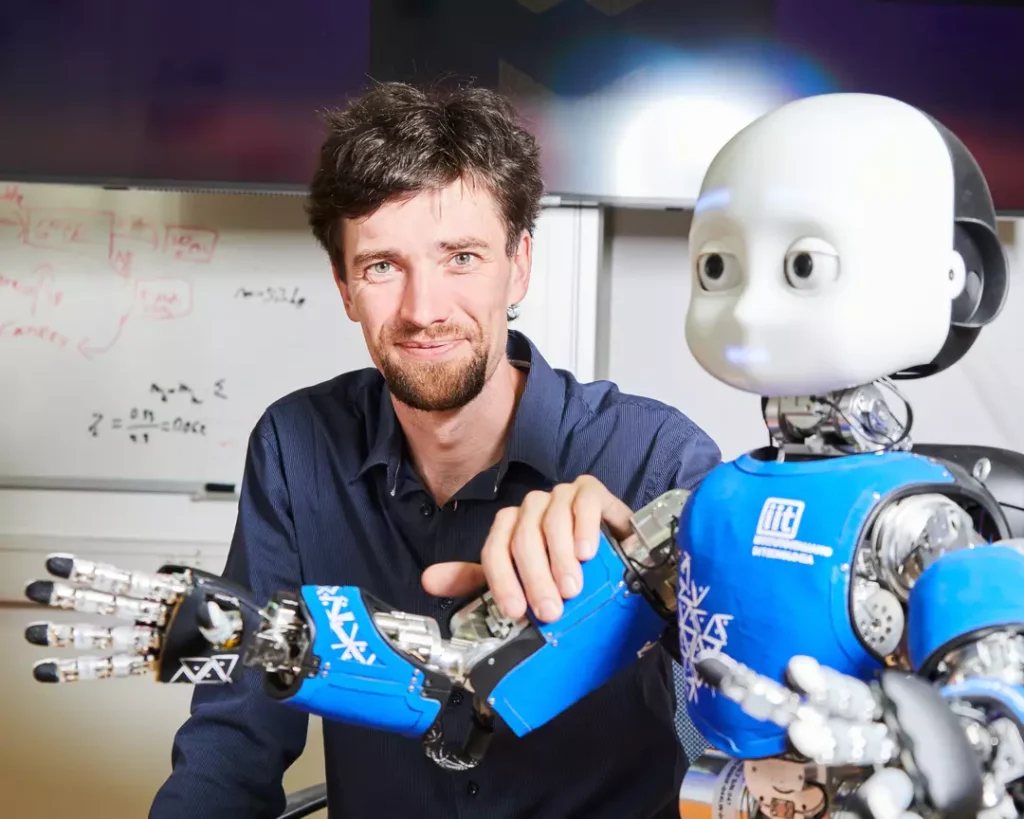
Researchers from institutions in Czechia, Italy, Denmark, Switzerland, the United Kingdom, the United States, Pakistan, and Singapore present a novel framework for evaluating robotic systems that combine neuromorphic computation—inspired by the functioning of the nervous system—with the physical body of the robot and its interaction with the environment. The first author of the study is Assistant Professor Dr. Giulia D’Angelo, and a co-author is Associate Professor Matěj Hoffmann, both from the Department of Cybernetics at the Faculty of Electrical Engineering, Czech Technical University in Prague (CTU FEE).
Growing focus on embodied intelligence
The development of robots capable of operating outside laboratory conditions faces a fundamental challenge: it is no longer sufficient for a robot to simply complete a task. It must do so quickly, reliably, with low energy consumption, and safely in interaction with its surroundings.
This is why increasing attention is being paid to so-called embodied intelligence—an approach in which intelligent behaviour does not arise solely from a “computational brain,” but from the interaction between control, body, and environment.
“Today’s robotic systems can no longer be evaluated solely based on whether they achieve a goal. We also need to consider how quickly they respond, how efficiently they use energy, how well they adapt to changes in the environment, and how effectively they exploit the properties of their own body. We argue that neuromorphic computing and soft robotics together offer a natural solution to these challenges. This is exactly what the proposed benchmarking framework aims to address,” says Dr. Giulia D’Angelo from CTU FEE.
New metrics for a new generation of robots
The study proposes a framework that combines traditional robotics metrics with new indicators better suited to capturing the behaviour of biologically inspired systems. It goes beyond simple task success and includes factors such as response time, energy consumption, adaptability, system complexity, and environmental impact.
The framework also introduces a set of benchmark tasks designed to evaluate these systems in more realistic scenarios. These include navigation among static and dynamic obstacles, locomotion across varied terrains, adaptation to changes in the robot’s mechanical properties, and manipulation of both rigid and deformable objects.
“The goal is to provide the research community with a shared, open, and reproducible foundation for fairly comparing different approaches to robot control under conditions that more closely resemble the real world,” adds Dr. Giulia D’Angelo.
When the body is more than just a carrier
The study bridges two rapidly developing areas of robotics: soft robotics and neuromorphic technologies. Neuromorphic systems mimic the functioning of biological nervous systems, enabling fast and energy-efficient information processing.
Soft robotics, in contrast to traditional rigid robots made of metal and plastic, uses compliant materials such as silicone. These robots often lack classical joints and can exhibit virtually infinite degrees of freedom — similar to biological systems like an octopus arm. This design allows for safer interaction with the environment and greater adaptability. One of the pioneers of this field, and a co-author of the study, Cecilia Laschi, led the well-known Octopus robot project.
According to the authors, the combination of soft robotics and neuromorphic technologies opens the door to robots better suited for operation in dynamic, unpredictable, or hazardous environments.
“What is particularly valuable about this work is that it highlights the need to evaluate robotic systems as a whole. Intelligence does not reside only in the control architecture but emerges from the continuous interaction between computation, body, and environment. This is an area we have been focusing on at CTU FEE for a long time,” says Associate Professor Matěj Hoffmann, co-author of the study and head of the Humanoid Robotics Group at the Department of Cybernetics.
Giulia D’Angelo develops research at the intersection of neuroscience, AI, and robotics at CTU FEE
The publication further confirms the scientific profile of Dr. Giulia D’Angelo, who conducts research at CTU FEE at the intersection of neuroscience, artificial intelligence, and robotics. As an Assistant Professor, she leads the Neuro-inspired Perception and Cognition Lab, which focuses on leveraging event-based vision and neuromorphic computing for energy-efficient real-time active vision systems in robotic applications.
CTU FEE has previously highlighted her work in connection with the international Le Tecnovisionarie® 2025 award, and the Nature Communications Editors’ Highlights, which she received for both her research and its broader societal impact.
The new study fits into a broader research direction at CTU FEE that combines biological inspiration, neuromorphic computation, and robotic systems capable of adaptive behaviour in real time.
About the study
The study A Benchmarking Framework for Embodied Neuromorphic Agents was developed through international collaboration among researchers from several European and non-European institutions, including the University of Cambridge and ETH Zurich. Contributors from CTU FEE include Dr. Giulia D’Angelo and Associate Professor Matej Hoffmann from the Department of Cybernetics. The paper proposes an open framework for evaluating robotic systems that integrate neuromorphic control, physical embodiment, and environmental interaction.
This article is based on a press release from FEE CTU.
