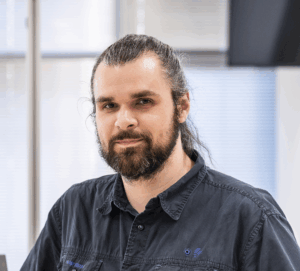
Imagine a robot handing you tools on a production line. Everything works well as long as the human behaves as expected. But what happens when the person suddenly changes strategy or uses a subtle movement the machine does not recognize? This very challenge, the ability to adapt, is the focus of Radoslav Škoviera, a researcher in the Robotics Perception (ROP) team at CIIRC CTU, who works on this topic together with his colleagues. Modern collaborative robotics is no longer limited to repeating predefined movements. Instead, it seeks ways to teach machines to understand the structure and context of human actions. Radoslav focuses not only on machine perception and learning but also on practical human–machine collaboration scenarios, where it is crucial that robots can respond to unexpected changes in human behavior and adapt to dynamic environments.
In recent years, the debate about autonomous systems has evolved significantly. While earlier discussions focused mainly on technical capabilities, the emphasis today increasingly lies on understanding — the machine’s ability to perceive situations, interpret human behavior, and react to context that is not strictly predefined. “In the lab, everything is predictable. In the real world, people change their strategies every second, often entirely intuitively,” explains Radoslav Škoviera. “Robots must be able to detect these changes and adapt without failing.”
One of the key principles explored by the team is multimodality. This means that systems do not rely solely on visual information but combine it with tactile perception, spatial data, and task context. A practical example is a robot learning to hand over tools. “It’s not just about recognizing the object’s shape and size,” Škoviera explains. “The robot must also understand how the human holds it, how they move, and how they react to unexpected obstacles. The ability to learn from demonstration and transfer skills into real environments allows machines to remain flexible and reliable even outside the laboratory.”
How Robots Perform Today (and What Still Lies Ahead)
Research into human–robot collaboration has advanced considerably in recent years. Many individual solutions already work very well today, for example, natural language recognition, detection of known objects, or flexible learning of specific subtasks without traditional programming. “These approaches are already functional and deployable,” Škoviera says, “but the main challenge remains reliability in changing environments and transferring learned skills to new yet similar objects or situations.”
Karla Štěpánová, who leads the ROP research group, agrees and adds: “The key challenge is achieving the quality required by industrial standards, particularly in terms of accuracy, repeatability, and robustness.” According to her, this is largely a matter of time. The goal is to develop accessible and easily retrainable models connected with expert knowledge and a safety verification layer. Such systems would be robustly adaptable for small-batch manufacturing and easily trainable for new tasks. “As a positive sign, similar technologies are already working in practice,” Štěpánová notes. “For example, some startups such as Robotwin are deploying systems capable of learning tasks flexibly without programming. I therefore expect that most of today’s challenges, especially reliability and adaptability, will be gradually overcome in the coming years.”
Within the European project ELLIOT, she and her colleagues are also developing open multimodal models designed to operate reliably in real-world environments. These models combine images, video, audio, text, 3D data, and sensor inputs. Their goal is to create systems that are adaptable, predictive, and capable of collaborating with humans without constant supervision.
Between the Laboratory and the Factory Floor
During his presentation at the ROBOTY 2026 conference, Radoslav Škoviera also had the opportunity to discuss practical industrial needs with companies. “We often encounter skepticism toward flexible or ‘smart’ solutions, sometimes even outright distrust,” he says. According to data from the International Federation of Robotics (IFR), the Czech Republic ranks among countries with high robot density. However, this is largely driven by automation in the automotive industry. As a result, small and medium-sized enterprises may lag behind in robotization. Current market solutions often focus on robust integration of proven technologies (such as marker detection approaches known in Czech research for decades) rather than adopting more advanced systems. This creates a widening gap between modern research and real-world industrial applications.

At the same time, Škoviera notes a more optimistic trend: “Progressive companies are emerging that understand automation will soon be a necessity rather than a choice. These companies also realize that standard automation solutions designed for large-scale production, or current approaches to shared human–robot workspaces, often do not meet their needs.”
Where Ideas Become Solutions
Radoslav’s research contributes to several major projects in which the ROP team and other CIIRC CTU groups are currently involved. One of them is ROBOPROX, which responds to the needs of Czech industry by offering modular solutions for advanced manufacturing. The project connects systems theory, materials engineering, and simulations of modular structures. It provides hundreds of scientists, PhD students, and postdoctoral researchers with the opportunity to test new algorithms directly in practice.
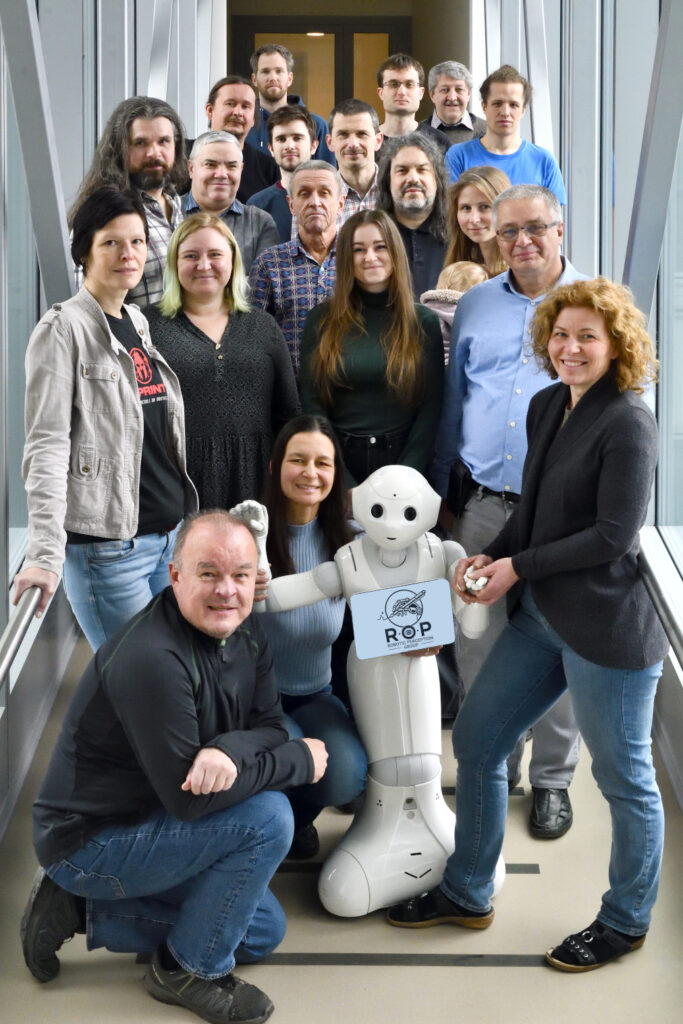
Another long-term initiative is the GA ČR JUNIOR STAR 2026 project led by Karla Štěpánová. This research focuses on personalized systems that learn from users through interactive dialogue and multimodal input. “Every user works differently and has unique habits and ways of interacting with technology,” Škoviera explains. “Our goal is for systems to capture these nuances and adapt to individual needs.”
Beyond practical applications, Radoslav’s research also has a strong theoretical dimension. It explores principles of adaptation, learning, and cognitive information processing that enable machines to understand uncertainty, predict human behavior, and adapt to dynamic situations. The result is systems that not only meet technical requirements but are also intuitive and trustworthy for humans — an essential condition for safe collaboration in industry, healthcare, and interactive technologies.
The Future of Intelligent Collaboration
According to Radoslav, the next steps will involve autonomous systems increasingly learning from humans, adapting to new situations, and predicting human behavior rather than relying solely on predefined algorithms. Projects such as ROBOPROX, ELLIOT, and JUNIOR STAR demonstrate concrete ways to apply these principles and show that connecting scientific research with real human needs can have a tangible impact. “Our goal is not just to develop sophisticated algorithms,” Škoviera concludes. “We want systems to be understandable, safe, and useful — to truly collaborate with people and make their work more efficient and more enjoyable.”
About Radoslav
Radoslav Škoviera is a researcher at the Czech Institute of Informatics, Robotics and Cybernetics (CIIRC CTU) at the Czech Technical University in Prague. He is a member of the Robotics Perception Group (ROP), led by Karla Štěpánová, which is part of the Robotics and Machine Perception (RMP) department. The group focuses on machine perception in a broad sense, from computer vision and tactile sensing for manipulation to cognitive approaches to human–system interaction. In addition to his home group, Radoslav is also active in the Imitation Learning Centre, an interdisciplinary network of researchers across CIIRC CTU that focuses on learning from demonstration, multimodal interaction, and transferring human skills into technical systems.